Source code navigation
You can quickly navigate through your code in the editor using different actions and popups.
You can start with watching a video tutorial to check what navigation options are available in MPS.
Navigate with the caret
To see the previous caret position, select from the main menu or press Ctrl+Alt+Left. To move forward, select or press Ctrl+Alt+Right.
To quickly move to the top of the editor, press Ctrl+Page Up. To move the caret to the bottom of your editor, press Ctrl+Page Down.
To navigate to the last edited location, press Ctrl+Shift+Backspace.
To find the current caret location in the editor, press Ctrl+M. This action might be helpful if you do not want to scroll through a large file.
Alternatively, you can press Up and Down arrow keys to achieve the same result.
To highlight a word at the caret you are trying to locate, select from the main menu. If you are using Windows, you can also press Ctrl+F3.
To see on what element the caret is currently positioned, press Alt+Q.
To move caret between matching code block braces, press Ctrl+Shift+M.
To navigate between code blocks, press Ctrl+[ or Ctrl+].
Move the caret
You can use different actions to move the caret through code. You can also configure where the caret should stop when moved by words and on line breaks.
To move the caret to the next word or the previous word, press Ctrl+Right or Ctrl+Left.
By default, MPS moves the caret to the end of the current word. When you move the caret to the previous word, it is placed at the beginning of the current word.
You can customize the caret position for these actions. In the Settings dialog (Ctrl+Alt+S) , go to . In the Caret Movement section, use the When moving by words and Upon line break options to configure the caret's behavior.
To move the caret forward to the next paragraph or backward to the previous one, press Ctrl+Shift+A and search for the Move Caret Forward a Paragraph or Move Caret Backward a Paragraph action.
You can also select a text and then move the caret forward or backward to a paragraph. Press Ctrl+Shift+A and search for the Move Caret Forward a Paragraph with Selection or Move Caret Backward a Paragraph with Selection action.
Find node by ID
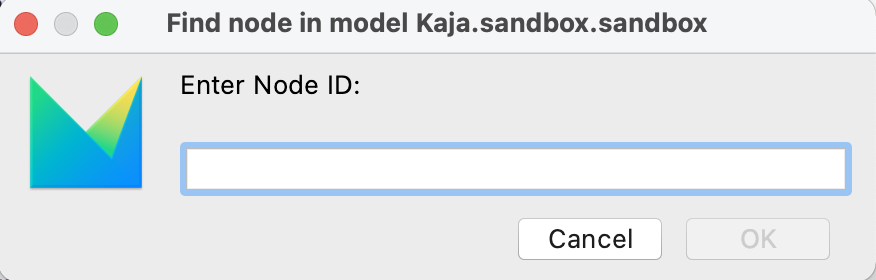
In the Find node in model dialog, specify an ID of the node to search for and click OK.
Tooltips
In the editor hover over some cells. A small pop-up window with additional information will show up after a short delay.
Not all cells have tooltips defined. Use the "tooltip radar" to visualize all cells with a tooltip defined - just press and hold the Control key and then move the mouse pointer.
Locate a code element with the Structure view popup
You can use the structure view popup to locate a code element in the file you are working on.
To open the structure view popup, press Ctrl+F12.
In the popup, locate an item you need. You can start typing a name of the element for MPS to narrow down the search. Press Enter to return to the editor and the corresponding element.
While in the popup, you can sort file members, see anonymous classes and inherited members.
Use bookmarks for navigation
To create an anonymous bookmark, place the caret at the needed code line and press F11.
To create a bookmark with mnemonics, place the caret at the needed code line, press Ctrl+F11 and select a number or a letter for the mnemonics.
To show the next or the previous bookmark, in the main menu select or .
To open the Bookmarks dialog, press Shift+F11. You can use this dialog to manage bookmarks, for example, delete, sort bookmarks, or supply them with a brief description.
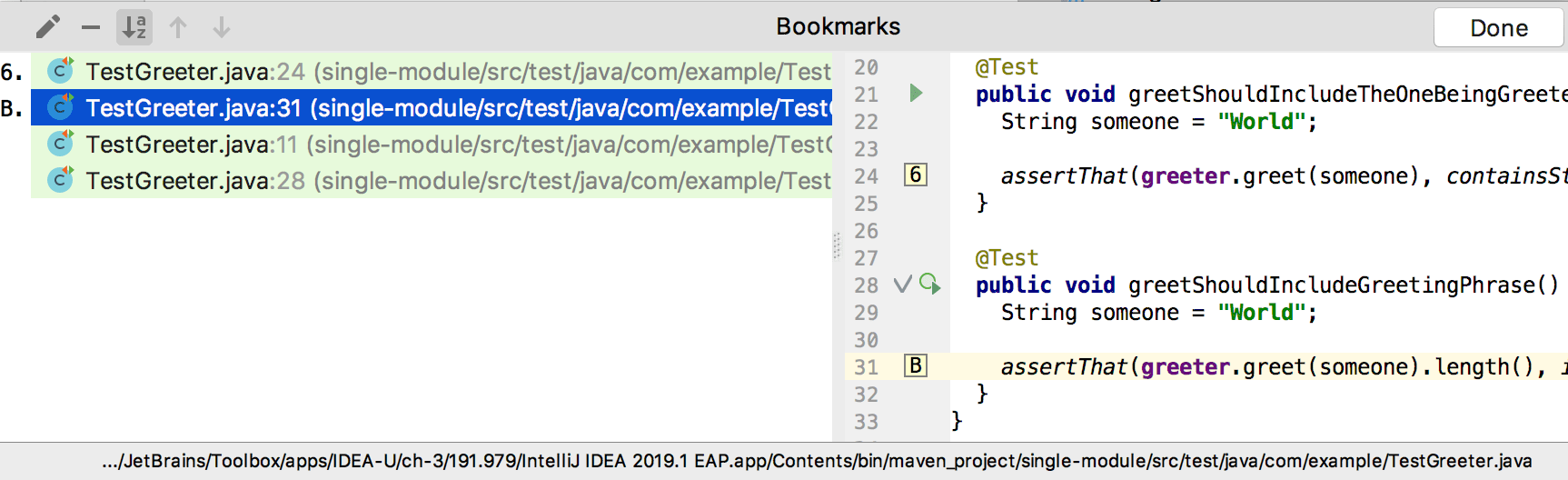
To navigate to an existing bookmark with letter mnemonics, press Shift+F11 and then press a letter you need. MPS returns you to the editor and to the corresponding bookmark.
To navigate to an existing bookmark with number mnemonics, press Ctrl and the bookmark's number.
You can check how to toggle between bookmarks with mnemonics, in the settings (Ctrl+Alt+S), on the Keymap page under the Other node.
Navigate between code elements
Go to declaration and its type
You can navigate to the initial declaration of a symbol and the symbol's type from its usage.
Place the caret at the necessary symbol and press Ctrl+B.
For a type declaration, press Ctrl+Shift+B.
Go to implementation
You can keep track of class implementations and overriding methods using the gutter icons in the editor, or by pressing the appropriate shortcuts, or by clicking Inheritors inlay hints.
Click one of the
 /
/ ,
,  /
/ gutter icons located in the editor and select an ascendant or descendant class from the list.
 To navigate to the super method, press Ctrl+U.
To navigate to the implementation, press Ctrl+Alt+B.
Use Inheritors hints that are displayed next to a class or an interface and show the number of its descendants. Click the hint to jump to the descendant. If there are several implementations, select the relevant one from the list.
Inheritors inlay hints are enabled by default. To turn them off, hover over a hint and select Hide 'Code Vision: Inheritors' Inlay Hints or Hide All 'Code Vision' Inlay Hints from the context menu.

By default, Inheritorshints are shown above classes and interfaces. To change this position, click Configure from the context menu of a hint.

On the Inlay Hints page, that opens, select the appropriate setting from the Position list. Alternatively, select the Code vision node and change the Default position for metrics.

Browse through methods
To visually separate methods in code, in the Settings dialog (Ctrl+Alt+S) , go to and select the Show method separators option.
To open the Structure tool window, press Alt+7.