Run/Debug configuration: XSLT
Create: 
Enable the XPathView + XSLT plugin
This functionality relies on the XPathView + XSLT plugin, which is bundled and enabled in DataGrip by default. If the relevant features are not available, make sure that you did not disable the plugin.
Press Ctrl+Alt+S to open settings and then select .
Open the Installed tab, find the XPathView + XSLT plugin, and select the checkbox next to the plugin name.
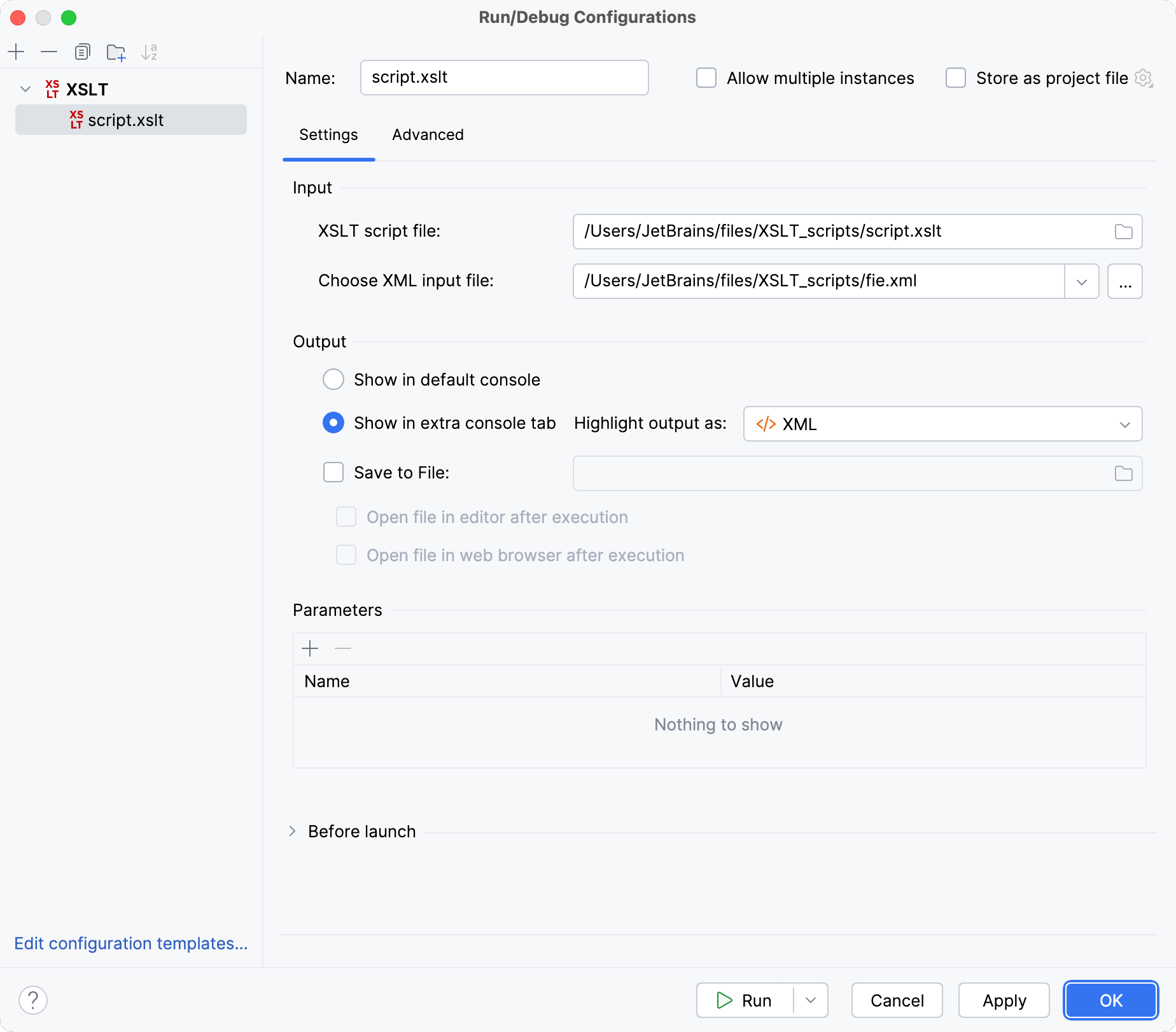
This page describes the configuration-specific items as well as options that are common for all run/debug configurations. For more information about using this configuration, refer to XSLT run configurations and Debugging.
Settings tab
Item | Description |
|---|---|
Input | Use the controls in this area to specify the XML file you want to process and the script you want to execute.
|
Output | Use the controls in this area to configure handling of the script output.
|
Parameters | Use the controls in this area to create and manage a list of parameters to be passed to the script.
|
 and select the desired file in the
  - click this button to remove the selected entry from the list.
Advanced tab
In this tab, configure additional options that are not commonly required in run configurations.
Item | Description |
|---|---|
Smart Error Handling |
|
VM Arguments | In this field, specify optional VM arguments to be passed to the VM where the XSLT script is executed. These can be heap size, garbage collection options, file encoding, etc. If the line of VM arguments is too long, click |
Working Directory | In this field, specify the working directory to use. Type the path manually or click Browse If no folder is specified in field, the working directory will be the one where the XSLT script file is located. |
 to expand the field and type the text there.
Common settings
When you edit a run configuration (but not a run configuration template), you can specify the following options:
Item | Description |
|---|---|
Name | Specify a name for the run configuration to quickly identify it among others when editing or running. |
Allow multiple instances | Allow running multiple instances of this run configuration in parallel. By default, it is disabled, and when you start this configuration while another instance is still running, DataGrip suggests stopping the running instance and starting another one. This is helpful when a run configuration consumes a lot of resources and there is no good reason to run multiple instances. |
Store as project file | Save the file with the run configuration settings to share it with other team members. The default location is .idea/runConfigurations. However, if you do not want to share the .idea directory, you can save the configuration to any other directory within the project. By default, it is disabled, and DataGrip stores run configuration settings in .idea/workspace.xml. |
Before launch
In this area, you can specify tasks to be performed before starting the selected run/debug configuration. The tasks are performed in the order they appear in the list.
Item | Shortcut | Description |
|---|---|---|
| Alt+Insert | Click this icon to add one of the following available tasks:
|
| Alt+Delete | Click this icon to remove the selected task from the list. |
| Enter | Click this icon to edit the selected task. Make the necessary changes in the dialog that opens. |
| Alt+Up Alt+Down | Click these icons to move the selected task one line up or down in the list. The tasks are performed in the order that they appear in the list. |
Show this page | Select this checkbox to show the run/debug configuration settings prior to actually starting the run/debug configuration. | |
Activate tool window | By default this checkbox is selected and the Run or the Debug tool window opens when you start the run/debug configuration. Otherwise, if the checkbox is cleared, the tool window is hidden. However, when the configuration is running, you can open the corresponding tool window for it yourself by pressing Alt+4 or Alt+5. | |
Focus tool window | Select this checkbox to automatically move focus to the Run or the Debug tool window when you start the run/debug configuration. |


Logs
The following options are related to logging the execution of this configuration. For more information, refer to .
Item | Description |
|---|---|
Specify logs to be shown in the console | Specify which log files to display while running the application. Click
For logs in the table, you can configure the following options:
|
Save console output to file | Save the console output to the specified location. Type the path manually or click the browse button and point to the desired location in the dialog that opens. |
Show console when a message is printed to stdout | Activate the console when the application writes to the standard output stream. |
Show console when a message is printed to stderr | Activate the console when the application writes to the standard error stream. |